The profit & loss statement summarizes the revenues, costs, and expenses incurred during a specific period, usually a fiscal quarter or year. It is also known as the Income Statement.
It can help you in assessing your organization's operational efficiency and profitability. It helps in understanding if your organization is generating profit or incurring losses, guiding decision-making regarding cost control and revenue generation strategies
Yes, you can select any date range to view the profit & loss statement of that particular time frame. Alternatively, you can use pre-defined time ranges for quick date update.
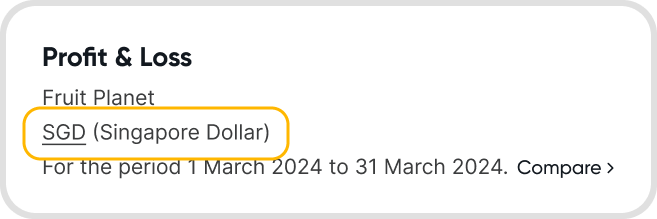
By default, the profit & loss statement will display values in your organization's base currency.
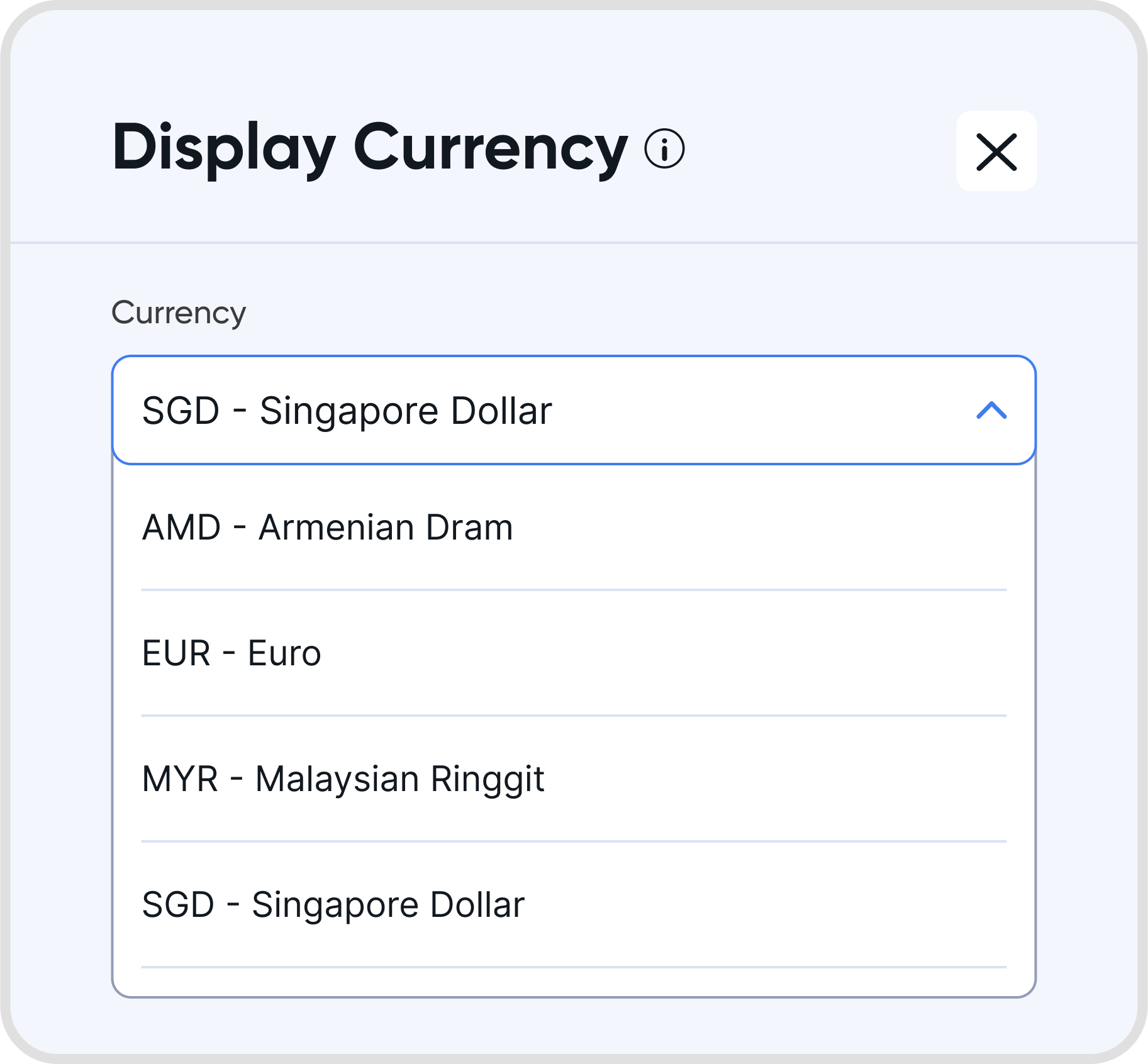
You can change the display currency of the profit & loss statement to other currencies that have been set up in your organization. For more information about setting up other currencies, refer to Accounting.
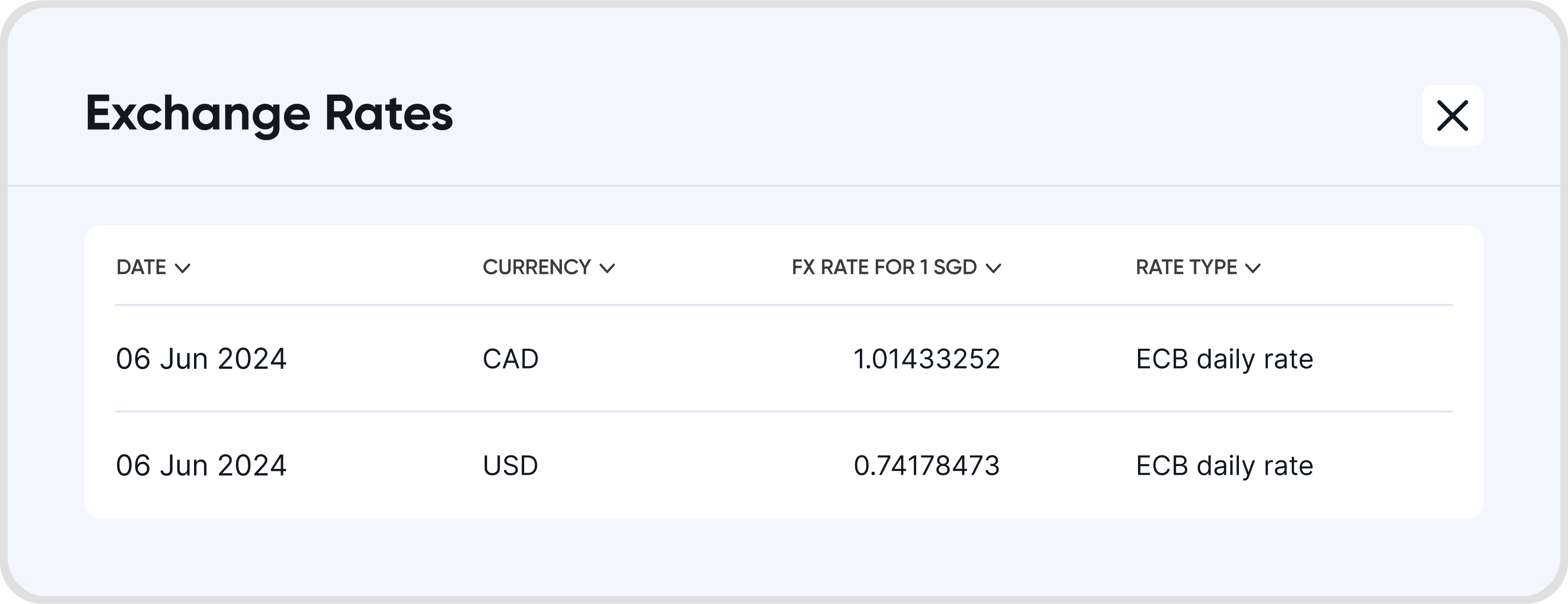
At the bottom of the page, click on See All Rates.
You will be shown a list of all exchange rates used to convert foreign currency transactions back to the organization's base currency.
Other information include the date of the exchange rate, as well as the rate type.

Yes. The Profit & Loss statement now supports deeper analysis by displaying the following as columns:
Tracking Tags: View tracking tags as columns.
Nano Classifiers: View nano classifiers as columns.
Contact Groups: View contact groups as columns.
Periods: View periods as columns based on your selected date range.
Common Size: Display percentage breakdowns alongside period columns for easier comparison.
Note: If the selected period has no matching data, no results will be shown. For example, applying a Nano Classifier for Q1 2025 while viewing Mar 2026 will return “No Nano Classifier” columns.
You can select a View By option to break down your Profit & Loss. For example:
View revenue by branch or business location using Tracking Tags.
Analyze performance by classification using Nano Classifiers.
Compare results across different periods.
Note: Dynamic amounts such as FX revaluation and unrealized gains/losses are not shown when viewing the report by tags or groups.
Yes, you can download the report in Excel or PDF formats.
See below for an example of the downloaded file.

Yes, enable Print Report Notes in Reports → Profit & Loss → Configuration Icon → Display Options to add and format notes below the report. These notes will be included in the exported report.
Yes. Click the Chart icon to open the Profit & Loss Chart view.
The chart allows you to visualize trends over multiple periods and switch between:
Amounts
Sales/Receipt
Cost of Sale
Gross Profit
Operating Expense
Operating Profit
Net Profit
Ratios, including:
Gross Margin
Operating Margin
Net Margin
This helps you analyze performance trends and profitability over time.
Note: The chart categories and labels are based on your selected report template.
Yes. In the chart view, click the “Periods” link to open the Compare Periods settings.
You can:
Compare with previous months
Select the total number of months to display
Adjust the display order
The chart will update automatically based on your selection.
Yes, enable Print Exchange Rates in Reports → Profit & Loss → Configuration Icon → Display Options to display them below the report. They will also appear in the exported report.
Yes, enable Print Rounded Values in Reports → Profit & Loss → Configuration Icon → Display Options to round all values to whole numbers. This also applies to the exported report.
Yes, profits or losses roll over dynamically. Changes to transactions or financial year-end will be reflected automatically in the Retained Earnings account.
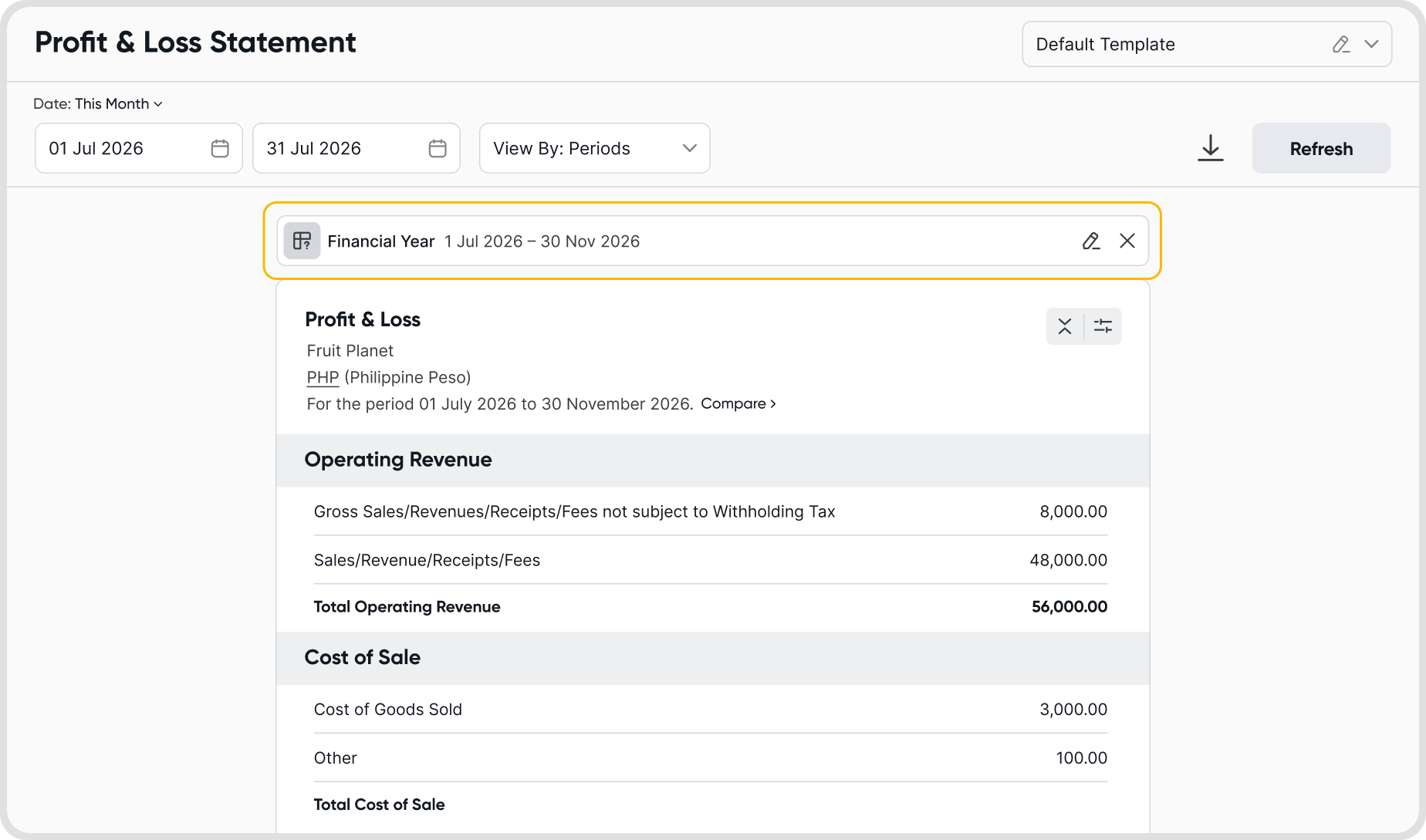
What-If runs a simulation of your Profit & Loss statement using assumptions you set, without changing any recorded transactions.
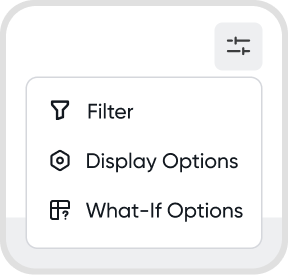
Go to Reports → Profit & Loss → Configuration Icon → What-If Options.
The simulation is preview only. Your actual account balances are never modified.
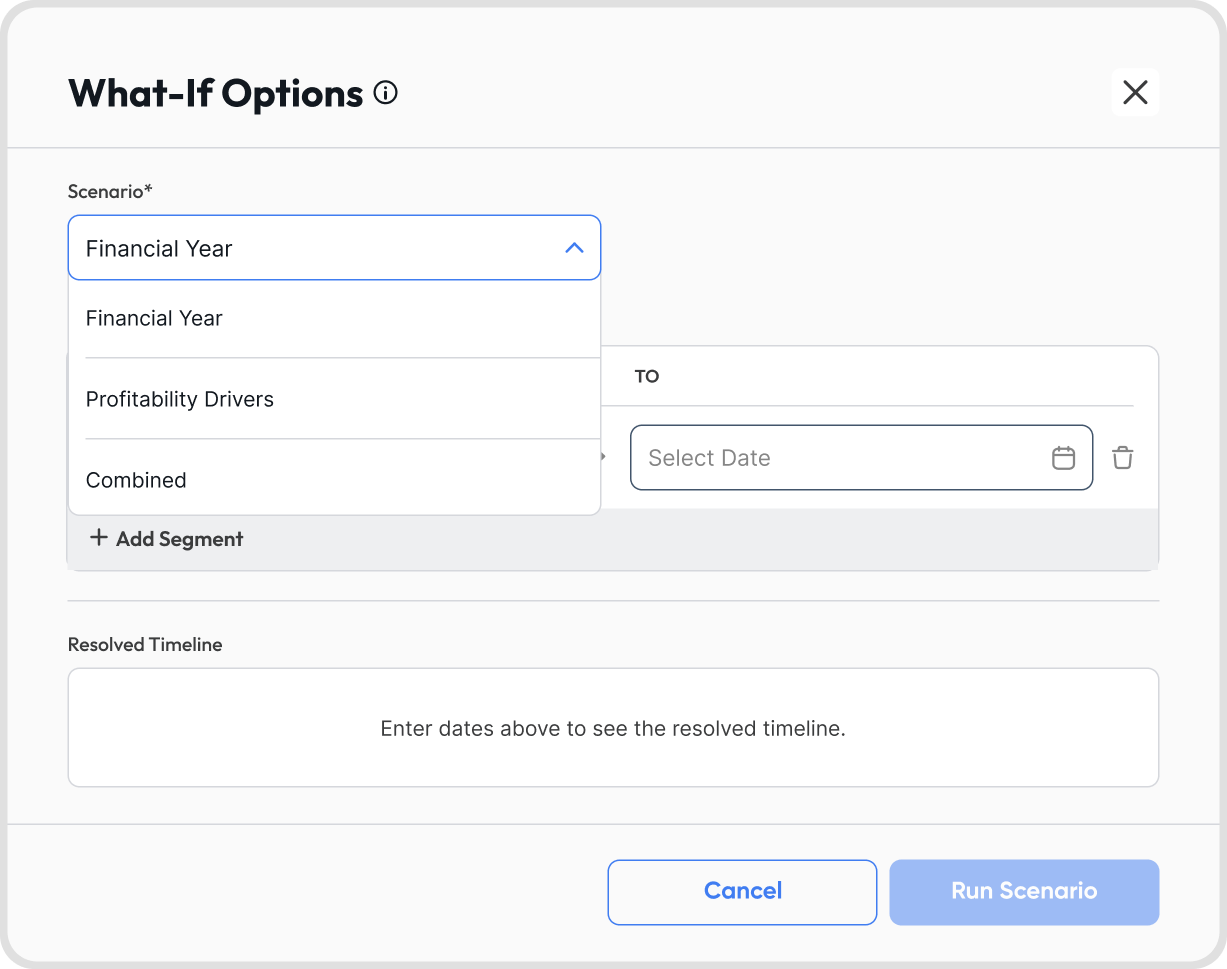
Financial Year: simulate custom financial year dates to view results over an irregular reporting period.
Profitability Drivers: apply a percentage adjustment to revenue or expense variables to see how results would respond.
Combined: apply a custom financial year and profitability drivers in the same simulation.
Each driver is built from three fields:
Scope: the level the adjustment applies to, either Account Type, Nature, or Account.
Target: the item being adjusted. Available targets depend on the scope selected. For Account Type, these are Direct Costs, Operating Expense, Operating Revenue, Other Expense, and Other Revenue.
Percentage: the adjustment applied to the target. Entering 20% multiplies the target by 1.20.
The Percentage field accepts values from -100 to 500:
Positive values increase the target. Entering 30% multiplies the target by 1.30.
Negative values decrease the target. Entering -25% multiplies the target by 0.75.
Entering -100% removes the target from the simulation entirely.
Values outside this range are rejected, and the simulation cannot be run until the entry is corrected.
Click + Add Driver to apply more than one adjustment in the same simulation.
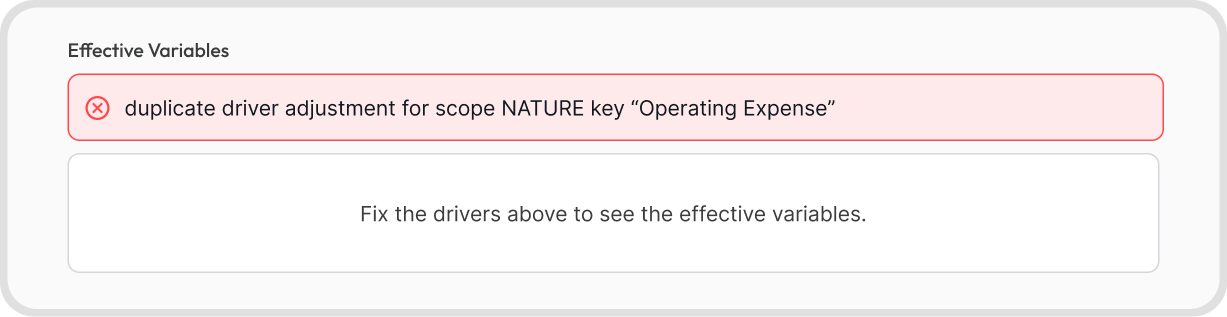
Each scope and target combination can only be used once. Adding a second driver for the same combination returns a duplicate error, and the simulation cannot be run until one of the drivers is changed or removed.
When drivers overlap across different scopes, the more specific scope takes priority: Account overrides Nature, and Nature overrides Account Type.
The Effective Variables panel shows the final multiplier applied to each scope before you run the simulation. If a driver is invalid, the panel displays the error instead of the multiplier.
Here are some example cases where What-If is helpful:
Testing a supplier price increase against your margin: if a supplier announces an increase, set Direct Costs to the expected percentage and review the effect on gross profit and gross margin before agreeing to new terms.
Modeling a revenue shortfall: set Operating Revenue to a negative percentage to see how far net profit falls if sales miss target, and whether the result still covers your fixed costs.
Pricing a wage or rent adjustment: set Scope to Account and select the specific salaries or rent account to model the increase on that account alone, without inflating the rest of Operating Expense.
Building next year's budget from actuals: apply growth assumptions to revenue and cost separately, for example Operating Revenue at 15% and Direct Costs at 10%, to produce a starting position without rebuilding the figures in a spreadsheet.
Reporting to a parent company with a different year end: if your parent closes on March 31 while you close on December 31, simulate the March year end to produce group reporting figures without maintaining a second set of books.
Matching your year end to your business cycle: if your peak season straddles your current year end, simulate a year end that falls after your peak to see how results look when a full cycle sits inside one period.
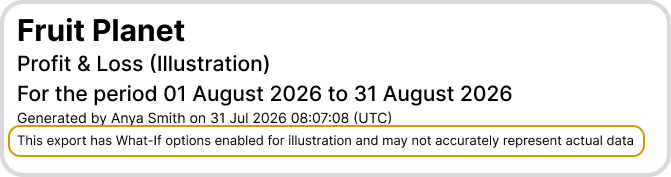
Yes, you can export the simulated report in Excel and PDF formats.
The exported file includes a note identifying the figures as the result of a What-If simulation and the report title has “(Illustration)”, so they are not mistaken for actual reported figures.