Go to Settings → Templates → Reports → Financial, then click + New Template (Profit & Loss).
Alternatively, go to Reports → Profit & Loss, click the template selector at the top right, and choose + New Template.
Juan provides two Profit & Loss templates:
Standard: organizes income and expenses into Operating Revenue, Cost of Sale, Operating Expense, Other Revenue, and Other Expense, with subtotals for Gross Profit, Operating Profit, Other Profit, and Net Profit.
IFRS 18: Structures the Profit and Loss statement into five groups:
Operating: Core business income and expenses, with Gross Profit and Operating Profit subtotals.
Investing: Income and expenses from investing activities, with Total Investing and Profit Before Financing and Income Tax subtotals.
Financing: Income and expenses related to financing activities, with Total Financing and Profit Before Income Tax subtotals.
Income Tax: Income tax expense, with a Profit from Continuing Operations subtotal.
Discontinued Operations: Results from discontinued operations, with Net Discontinued Operations and Net Profit subtotals.
The Profit & Loss template has three tabs: General, PDF, and Actions.
General: edit template name, baseline period, header, sorting, and footer.
PDF: customize layout, header, and footer for the PDF version of the report.
Actions: configure settings for a selected row or column.
Note: PDF preview and export are only supported for up to 8 columns.
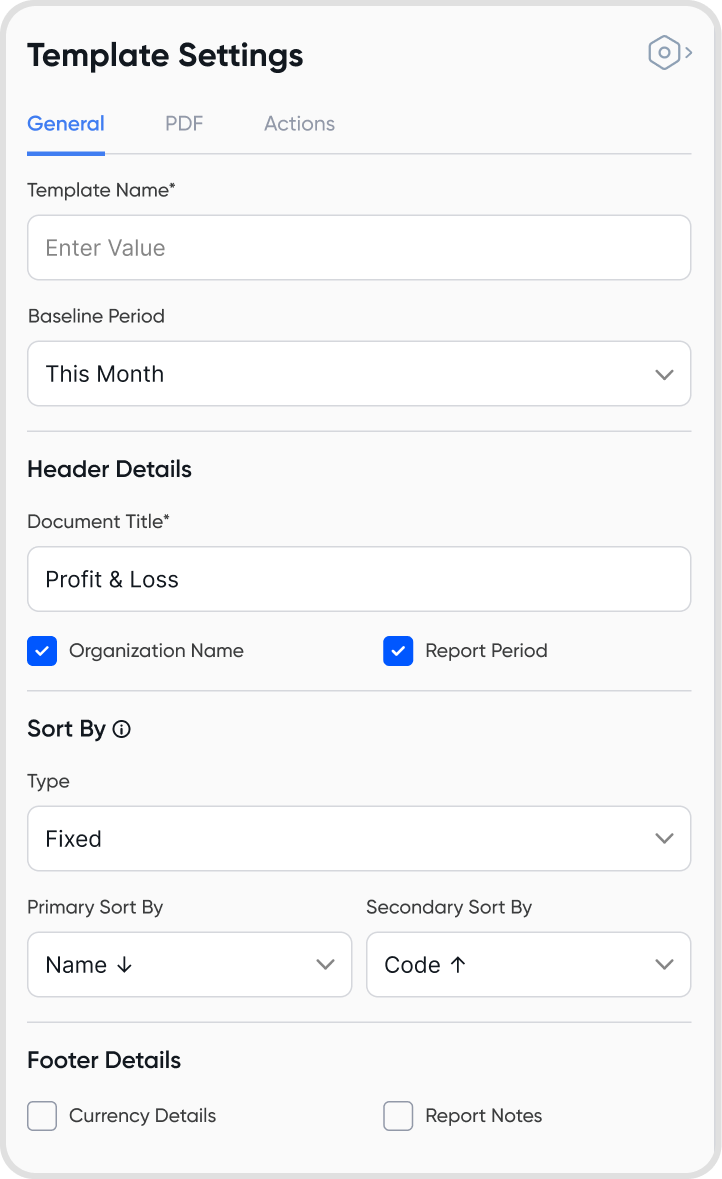
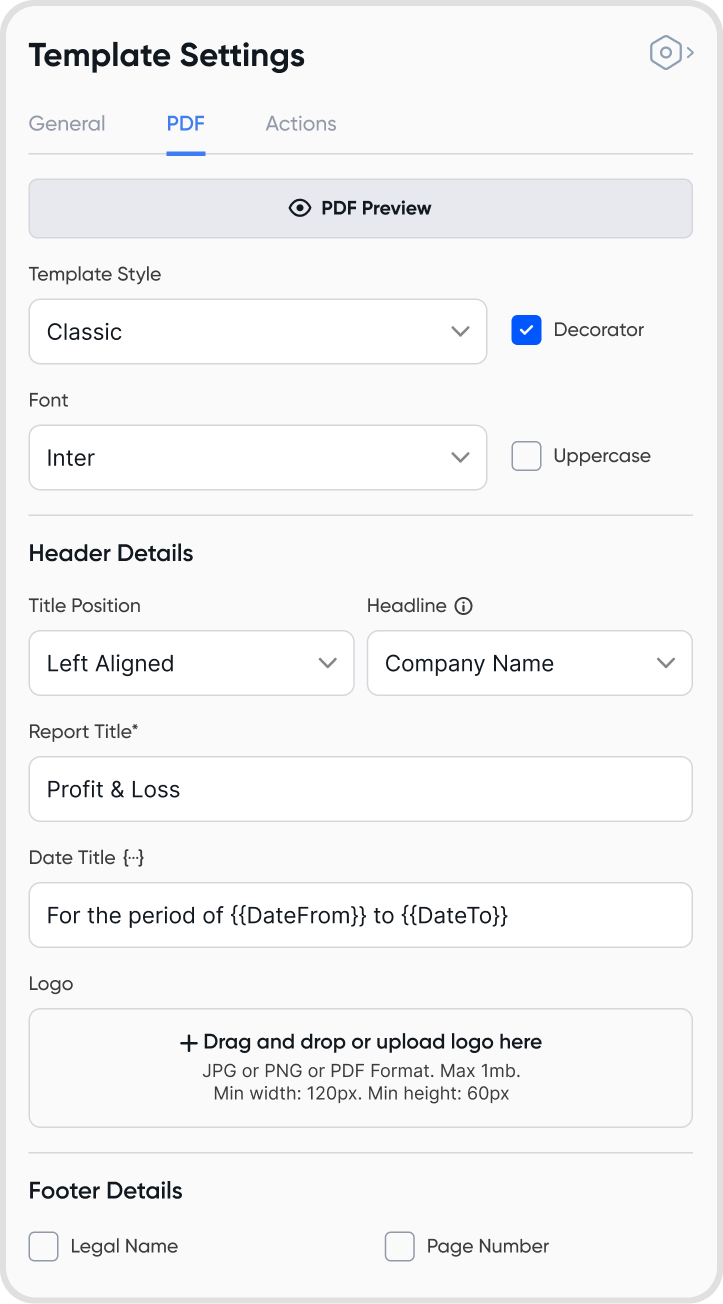
The baseline period controls how report dates are set relative to the date the report is run.
The available options are:
This Month
Financial Quarter
Financial Year
Last Month
Last Financial Quarter
Last Financial Year
Comparative Periods: choose a date range, comparison type (day, month, quarter, or year), and display order.
Variance: shows the change between two columns as an amount or percentage. Multiple variance columns are allowed.
Year-to-Date: shows cumulative totals from the start of the year to the selected period. Multiple allowed.
Account Code: displays Chart of Accounts codes. Only one Account Code column is allowed.
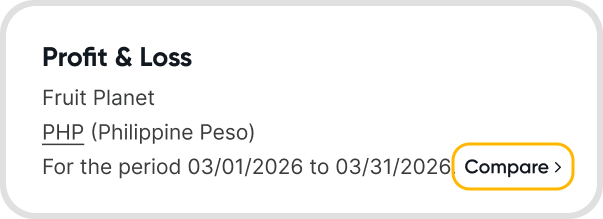
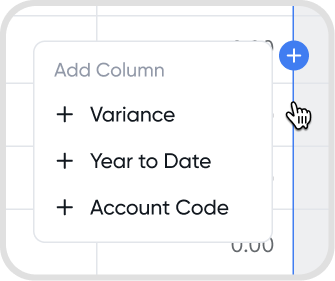
By default, only the baseline period column is shown.
To add columns:
Click Compare to add additional period columns.
Hover over a column line to add Year-to-Date or Account Code columns.
Hover over a column line to add a Variance column once at least two period columns are available.
To delete a column, click the column, then under Actions, select Delete Column.
Group-level Rows: represent a group of accounts. You can:
Rename the group.
Show or hide group totals.
Hide the group if all child rows are hidden.
Set account criteria to define which accounts are included.
Set negative balance rules.
Child-level Rows: represent individual account rows. You can:
Create new account groups.
Set negative balance rules.
Group selected accounts together using Create New Account Group.
Text Rows: custom text rows that can be added at both group and child levels.
To add a Group Row, hover over a row line and click + Account Group. Enter the group name and account criteria.
To add a Text Row, hover over a row and select Add Text Row. Text rows can be added at both group and child levels.
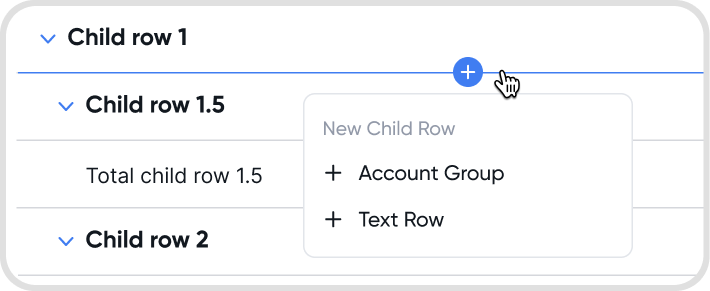
Yes. Click on the group row and rename accordingly.
Yes. You can add sub-groups within an existing group row.
The Negative Balance rule defines what happens when an account amount falls below zero. Rules can be applied at both the group and child levels.
Group Row Rules: choose conditions such as "if accounts are negative" or "if the entire group is negative." You can move negative balances to another group or convert them to positive values.
Child Row Rules: when an individual account is negative, you can move it to a selected group.
Note: Child row rules take precedence over group row rules. Check for conflicts when both are applied.
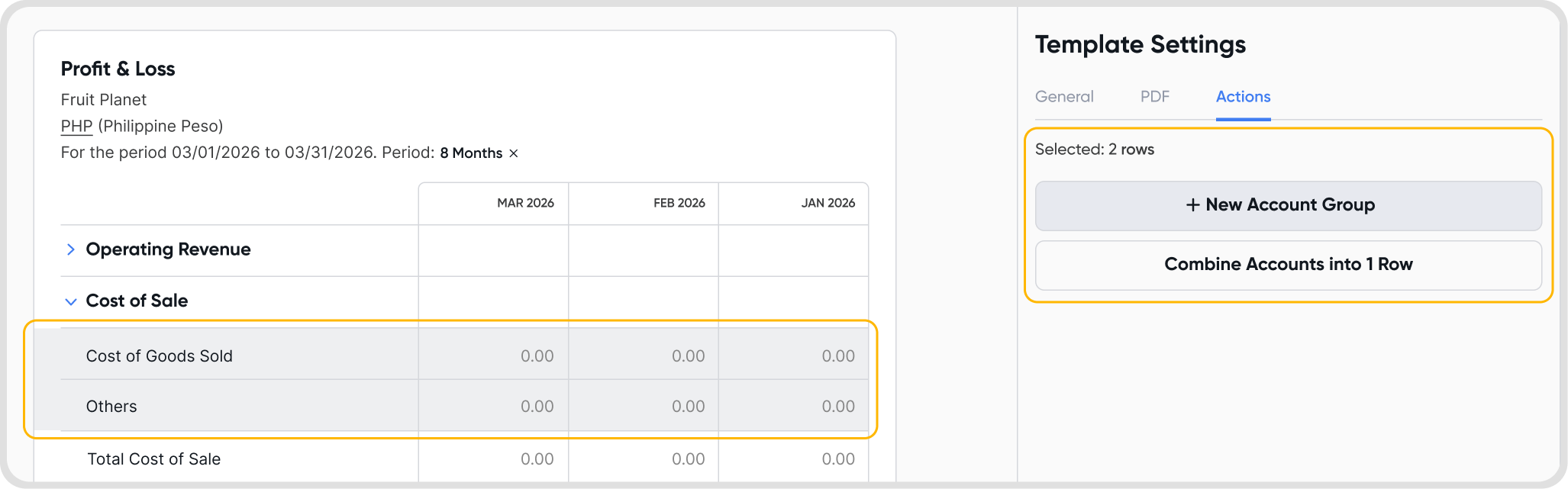
To combine accounts into a single row or group:
Press Cmd/Ctrl + Left Click to select specific accounts individually, or Shift + Left Click to select a range.
From the Actions tab, choose to combine into a single row or group.
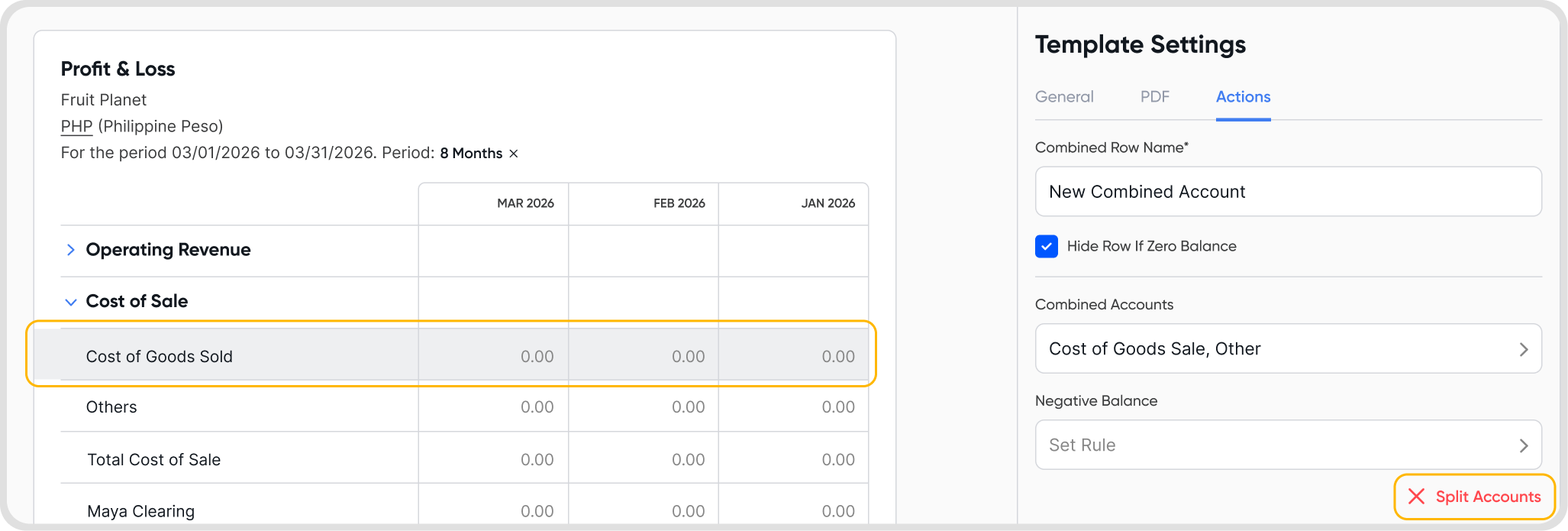
To split a combined row or group, select the row and from the Actions tab, select Split Accounts or Remove Group.
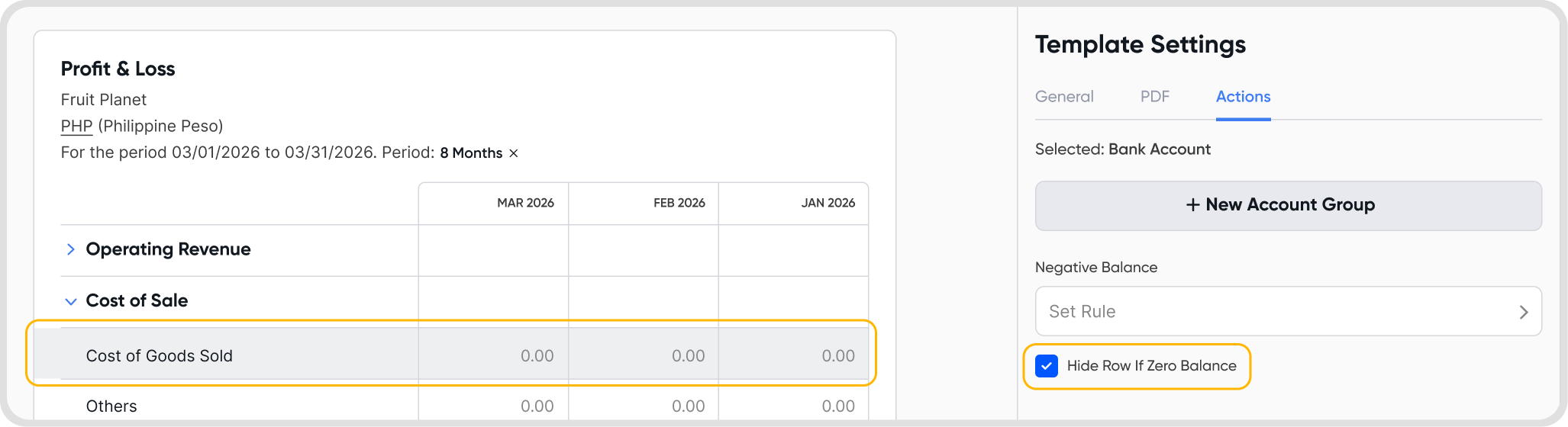
Select the row and enable Hide Row if Zero Balance.
Check your Chart of Accounts to ensure the account type is included in the Profit & Loss report.
Also verify that the account meets the criteria set for the relevant group row in your template.
Yes. New accounts added to your COA will automatically appear in your Profit & Loss template based on the criteria set for each group.
Enabling decorators adds a horizontal line at the top of the report.
Enabling uppercase converts all text in the report to uppercase.
Yes. Go to Settings → Template → Reports → Profit & Loss Add a Logo.
The logo file must be no larger than 1 MB, with a minimum width of 120px and minimum height of 60px.
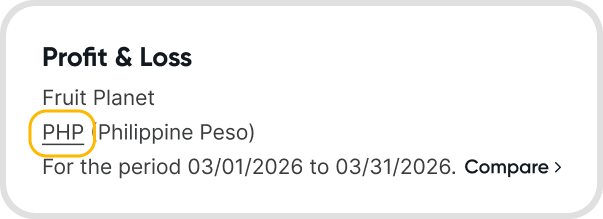
Yes. Click the base currency to change the display currency.
The report converts all values from base currency to the selected display currency using the exchange rate on the report date. If multiple periods are shown, the same exchange rate applies to all periods.
The dynamic string lets you configure the date title format in PDF exports using placeholders.
Example: “For the period of {{DateFrom}} to {{DateTo}}” will display as "For the period of 06/01/2026 to 06/30/2026" when the report is generated.

Yes. Go to Settings → Templates → Reports, hover over the template, and click Set as Default.
Yes. Go to Settings → Templates → Reports →hover over the template → click the 3-dot icon, and select Duplicate.
Yes. Hover over the template, click the 3-dot icon, and select Delete.
Note: If the template is set as the default, you must assign another template as the default before it can be deleted.
Yes. You can create multiple Profit & Loss templates to cover different reporting needs.
Changes apply immediately. For previously downloaded reports, redownload them to reflect the latest template updates.